Karnam Malleswari: India’s Olympic Weightlifting Hero

Who Is Karnam Malleswari:

Karnam Malleswari, popularly referred to as the Golden Girl of India, is the only Indian woman weightlifter to have won an Olympic medal. On 19 September, 2000, Karnam Malleswari made the entire nation proud by winning a bronze medal in weightlifting in the Sydney Olympics. She was born into a family of reputed weight lifters on 1st June 1975. 

Along with her four sisters she started her training at the tender age of 12. Under the tutelage of Neelamshetty Apanna, she began polishing her skills. Because of her exceptional weightlifting abilities, she got recognised by the Sports Authority of India after she moved to Delhi with her sister.

Karnam Malleswari Biography:

Name Karnam Malleswari
Real Name Karnam Malleswari
Gender Female
Date of Birth 1st June 1975
Age 46 Years
Profession Weightlifter
Zodiac Sign Scorpion
Martial Status Married
Personal Life Husband : Rajesh Tyagi
Place of Birth Amadalavalasa, Srikakulam

About Karnam Malleswari Journey:

Karnam Malleswari’s career took a leap in 1991, when she was a 16 year old, won the silver at the senior Nationals in Ambala. This opened the door for hope to shine brighter in the days to come.

Malleswari continued winning medals in National and International events for her spectacular weightlifting feats. Karnam Malleswari has 29 international medals, out of which 11 are gold, Arjuna Award, Rajiv Gandhi Khel Ratna Award and Padmashri.

Karnam Malleswari Weightlifter:

After her Olympic win in 2000, Malleswari’s appearance in sports events started dwindling. Soon after the birth of her son in 2001, she announced retirement. Though she is not the tip of the tongue athlete and has never really had her name circulating in the sports fraternity, her achievement will always be deeply embedded in the history of India for her win was not only hers but of the nation .

Budithi Bell and Brass Crafts of Srikakulam: Tradition in Every Chime

Buditi is a small village towards the North East of Srikakulam with bubbling creativity and craftsmanship. A lot of people find joy and their livelihood in moulding and shaping alloys like brass , sheathing them with love and creating beautiful items which entice people toward it.

Initially only basic requirements like brass utensils were produced but with the passage of time, the art has evolved, a modern artistic touch has been added and the variety of items has expanded. Today, idols, pots , flower vases etc are made by them.

This art form was the brainchild of Budithi Addala Rama Krishna who after learning the art of drawing patterns on brass from his wife, started building the castles of his creativity. He produces a large number of brass items and sells it extensively. His items hold a place even in the international market. Impressed with his expertise in the art and his entrepreneurship the government has bestowed wayward on him. 

It is a thing of pride that the Budithi Brassware has been registered with the Geographical Indications of Goods (Registration and Protection) Act, 1999 as a handicraft of geographical indication.While the nation doesn’t sing its praise, the international market looks up to it. The cost of the articles are decided based on the intricacy of the work done on the items. 

The pages of history reveal that these craftsmen used to get royal patronage. They were mostly jewellers who dealt with precious metals to carve out gorgeous ornaments. But with the tides of time, eroded was their prosperity. Still they have been resilient enough to switch to brass and amaze the world again with the power of their creativity. Come to Budithi and the authentic manifestation of creative patterns through the age old art will certainly mesmerize you.


Ponduru Khadi of Srikakulam: Weaving the Threads of Heritage

Khadi is a revolutionary fabric and binds us all with the recollection of our collective win over the British imperialism. But unfortunately, we have forgotten to keep alive the place that spun the best quality Khadi . Ponduru, a small village 25 km away from Srikakulam has been producing super fine Khadi as a tradition since years. Men and women of the village are extensively involved in the art and are on toes to keep up the quality of the fabric produced.

Two types of cotton are used by the artisans. White hill cotton and red cotton for fine and coarse yarn respectively. The jawbone of Valuga fish is used to comb the cotton. This makes it different by adding a shiny and silky touch to the resulting cotton. At this stage the cotton looks elegant and immaculate. The craftsmanship is embedded in the flesh and bones of the locals and is sincerely passed on to the successive generations.

In 1949 Acharya Vinobha Bhabe founded the Andhra Fine Khadi Karmikabhivrudhi Sangam which is now functioning under the Khadi Village Industries Commission(KVIC), acts as a parent institution to support the spinning and weaving of the fabric. A total of 10 yarn purchasing centres have been established from which the cotton is supplied and yarn is collected.

Mahatma Gandhi was all praise for the high quality of Khadi produced in Ponduru. The finesse of the fabric surprised him. He had even sent his son Devdas to Ponduru to get an insight into the originality of the fabric. Overwhelmed by it, he mentioned Ponduru Khadi in ‘Young India’, a national newspaper published during the pre-independence era.

The art and the artists, both are enthralling. As you walk through the village, exchanging words with the artisans , devouring the process in which the fabric is produced, you cannot suppress the exigency to own a piece of the precious Ponduru Khadi. Let’s not allow this grand testimony of our glorious past to shrivel. Grace Ponduru with your presence, adorn yourself with the authentic , fine fabric and make its name reverberate in every corner of the globe.


Srikakulam’s Paper Jamdani: The Artistry of Handloom Excellence

Story Of Paper Jamdani:

Developed by Annaji Rao to compete with the affordable and bulk products of the mushrooming British power looms, Paper Jamdani or Alikam is an indigenous art that has reached the corners of the globe and upholds the power of nationalism, reminding  us of our victorious feat against the oppressive colonisation.  

Paper Jamdani Weaving:

Jamdani involves weaving a brocaded fabric with sporadic weft yarns. Alikam uses the tapestry technique to imbibe a picture on Jamdani fabric. Needless to say, Alikam requires a keen eye and extreme finesse in the skill. Since the work is very fine and intricate, it consumes a lot of time.

A couple of years are spent in completing a single saree. Of course with a greater number of skilled craftsmen, the task has become smoother and yields output in bulk for commercial purposes. 

Taking into consideration the efforts put into the art, it is obvious that each piece of fabric will be fetching a good sum. But knowing the actual price will baffle you. A single saree can cost you lakhs. Nevertheless, because of the sophistication, singularity and artistic opulence of the fabric, the demand is ever rising. Annaji’s client list bears the name of A list designers of national and international origin.

Annaji Rao’s Paper Jamdani Training Center:

Annaji has a training centre where he takes around 30 students per batch and helps them master the art of Paper Jamdani.  Students from National Institute of Fashion Technology also throng the place to hone the craft. 

Though Paper Jamdani is yet to get popularised in the general crowd, it is a highly revered art form in the professional circuit of textile professionals and among the connoisseurs of handicraft.

Though attempts are made by Annaji and his group to keep this alive, support from other governmental and non-governmental sources can push it a notch higher and in turn it can prevail as a testimonial art form, glorifying our triumphant past and cultural resplendence.

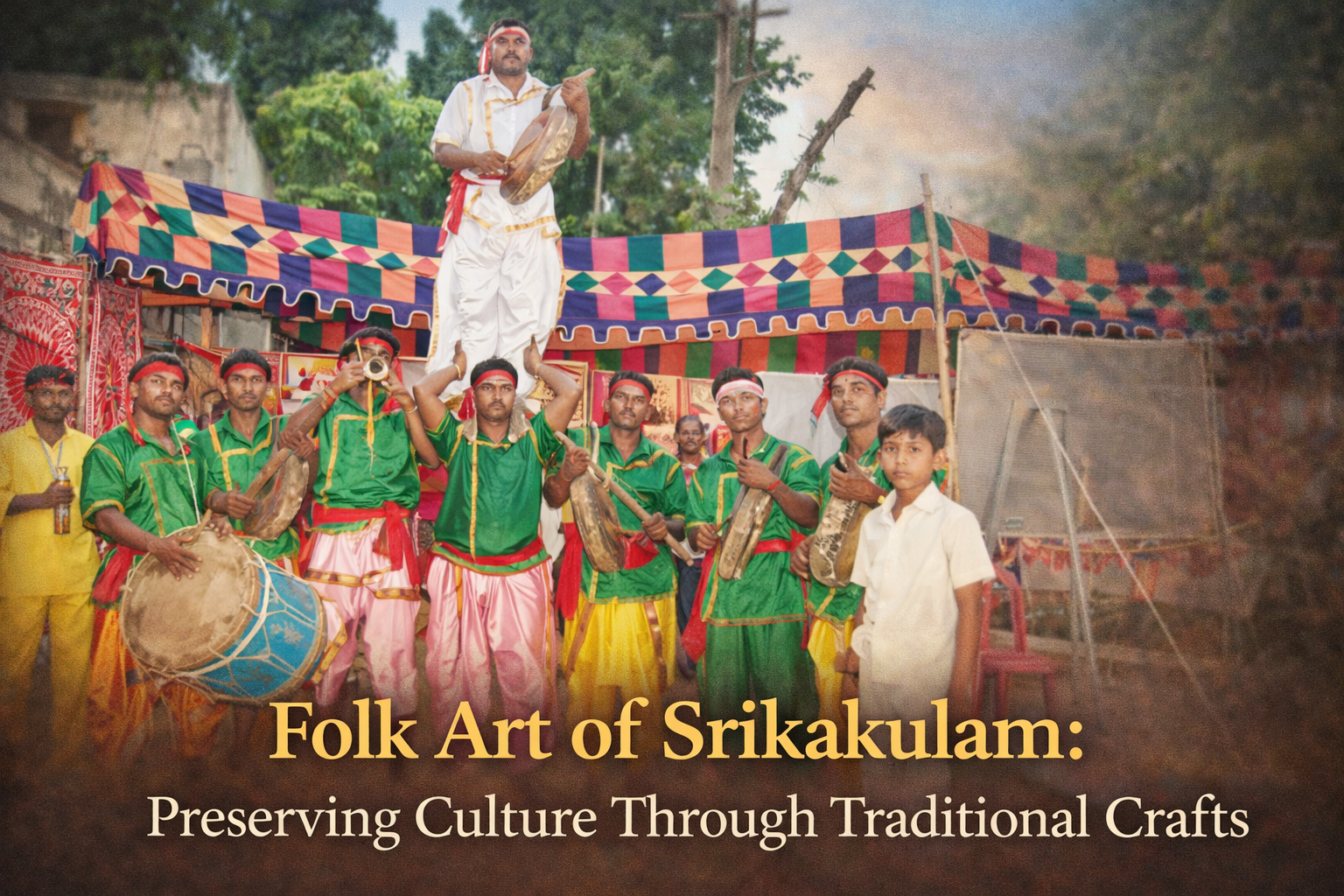
Folk Art of Srikakulam: Preserving Culture Through Traditional Crafts

Art forms are the joyous manifestation of the culture and tradition of a region. Be it dance or song or any other act, they are used as modes of expressions of the legends and history which have been woven over the years by our previous generations and are thirsty to be passed on to the posterity. 

Srikakulam is a land of cultural richness. A number of art forms have been performed for years to spread the word about the local traditions. Though the frequency of performance has decreased today, those being performed only in the festive seasons, people still find the beauty in it and take pride in their elaborate past.

Below are the most popular folk arts of Srikakulam.

Tappeta Gullu:

Tapetta Gullu is the most popular art form of the Srikakulam district. The art form is performed by the shepherd community. At night the artists sing songs to keep predators away from their sheep. This art form is focused on portraying man’s ability of transforming himself according to the environment and his power to tame the forces of nature as well. This form of art has a ritualistic association.

Tapetta Gallu is performed to invoke the blessings of the rain Goddess, Gangamma and Lord Vishnu.A man carries around a pot initially that symbolises the rain Goddess. It is followed by singing songs in melodious rhythm in the praise of Lord Vishnu.

Around 15 to 20 men present dance moves in synchronisation with the songs. They wear anklets and small drums around their chests.The drums are known as Tapetta Gundlu and hence the name Tapetta Gullu. Over the years, the art has evolved and today acrobatic feats have become a part of the art form. The artists are skilled and have acquired great stamina through practice.

Now, Tapetta Gallu is performed only during the festive season yet the enthusiasm of the artists as well as the audience to perform and consume the art is still the same.

Chenchu Bhagavatham:

This is another interesting art form, performed by a particular tribe by the name of chenchu. They dress very differently in tribal attire with garments of hide and headgears decorated with colorful feathers. Chenchu Bhagavatham is a narrative art form.

Descriptive songs infuse the surrounding, portraying the divine romance of Lord Vishnu and His consort. It was initially performed with the intention of spreading social welfare messages but gradually took the form of a folk art. A man dressed as a woman leads the performance by singing songs of mythological importance.

There are other artists to accompany who play percussion instruments called ‘Jamkus’. Though performed by the aboriginal tribal, a close look at Chenchy Bhagavatham will not only give an insight into our vast literature but also the traditional and cultural richness that we have pushed into insignificance.

Thimsa Dance:

One of the most intriguing art forms is Thimsa Dance. It is a mesmerising dance form performed by the tribal communities in the Eastern Ghats of Srikakulam. The village Seethampeta is especially famous for this. In Thimsa, the males and females are simply dressed yet are in joyous moods. The males sing romantic songs to attract the females to dance with them.

There are different forms of Thimsa . Some of them are Bode Thimsa, Bagh Thimsa and so on. The Savaras attach great value to it. During Chaitra Parvam, Savaras extend invitations to neighbouring villages and dance in uttar merriment.The Savaras call it Sankidi Kelchar.

MY MY Gurram:

This art form is also popular among the Savaras. They live a reclusive life on the hills. Nevertheless they make it a point to establish their cultural identity and make it wide spread. 

While performing one man gets dressed as a horse and dances to the tunes. Another man wears a devil’s mask and holds a bunch of grass. He utters My My Guram repeatedly which means Oh! Horse! Come!please come!.

Songs convey the quarrel story between a husband and wife which ends in compromise. It is extensively performed during the festive seasons where the artists go from door to door performing. It ends with the sacrifice of a pig in front of the Goddess and its subsequent distribution.

Chekka Bhajana:

This is an art form with immense devotional value. It is facilitated mainly by the temples. On special and pious occasions, like karthika masam and Ram Navami, around 20 villagers wearing uniforms, revolve around the deities, singing songs from the mythology.It is usually an intense folk art and gets performed for more than 10 hours and often throughout the night.

The kalpatharuvu which is a bronze tree with 108 lights is the centre of attraction. This art form gets its name from the percussion instrument ‘Chekka’ which is played by the artists to add rhythm to their songs. Though the modern educated youth find shy to perform this and do not express desire to absorb the art form, the word of cultural and mythological awareness it spreads can neither be forgotten nor undermined.

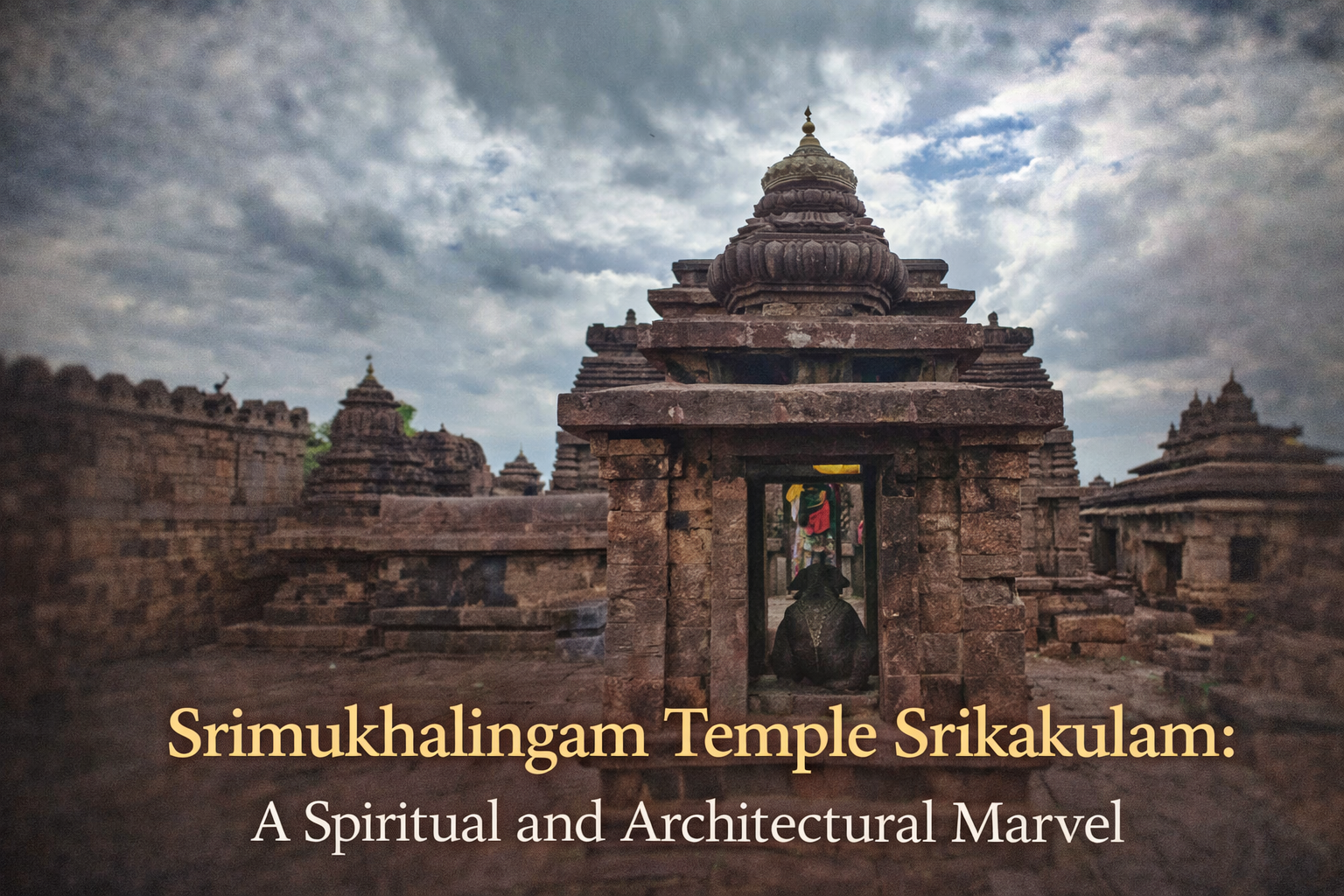
Srimukhalingam Temple Srikakulam: A Spiritual and Architectural Marvel

Mukhalingam is a quiet village, situated 56 km from Srikakulam in the Jalumuru Mandal. This village, on the banks of river Vamsadhara is the keeper of our illustrious past. Mukhalingam used to be the capital of the then Kalinga Kingdom and boasts of hosting the three temples dedicated to Lord Shiva, Madhukeswara, Someswara, Bheemeswara. Three of the temples stand testimony to the extraordinary finesse of architectural skills.

Local history narrates that once Chitasena tried to chop a madhuka tree which was worshipped as a linga and over which his two wives were fighting. While cutting down the tree, the face of Shiva showed up on the trunk.

Srimukhalingam Temple Srikakulam:

The Mukhalingeswar Temple is more elaborate in comparison to the other two temples of the trinity. The construction continued for two generations. Kamarnava II started building the temple in 9th century AD and it was completed by his grandson Immadi Vajrahasta.

The lingam has been carved out of a tree trunk and not a stone. Since the trunk of Madhuka(palm) tree is used, it is called Madhukaswara temple. The tree bears a carved structure that resembles a face and therefore the name, Mukhalingeswara.(mukha means face) .

Both sides of the gateway are gorgeously designed by carvings of Gods and Goddesses, mythological allusions and other structures. Two exquisite rock-cut lions are placed on both sides of the gateway. It is an epitome of the Indo-Aryan style of architecture and is recognised and protected  by the archaeological survey of India as a ‘monument of national importance.’

Idols Inside Srimukhalingam Temple Srikakulam:

The Bheemeswara temple is located proximal to the Mukhalingeswara temple. It was constructed by Aninayaka Bheeshwara. This temple is not as intricately carved as the Madhukeswara Temple. However, one of the most striking features is the two Nandi statues belonging to two different periods, housed in the temple. One belongs to the Ganga dynasty while the other to the Chola dynasty. Theportrayal of two different archeological styles is of much interest to the connoisseurs.

The Someswara Temple is also beautifully carved. On either side of the doorway are the sculptures of the river goddesses Ganga and Yamua. The gopuram or the gateway is resplendent with sculptures of Gods and Goddesses.

Shivaratri in Srimukhalingam Temple Srikakulam:

Shivaratri is celebrated at Mukhalingam with pomp and show for over three days.Pilgrims come here for Chkara teertha Snanam which they believe holds an important place in granting them salvation.Whether you believe it or not, a visit to Mukhalingam will etch a magnificent memory in your mind. The calm village, the spiritual overtones and the elegant artistry will surely bewitch you.

Srimukhalingam Temple Timings:

Monday 6:00 AM – 8:30 PM
Tuesday 6:00 AM – 8:30 PM
Wednesday 6:00 AM – 8:30 PM
Thursday 6:00 AM – 8:30 PM
Friday 6:00 AM – 8:30 PM
Saturday 6:00 AM – 8:30 PM
Sunday 6:00 AM – 8:30 PM

How To Reach Srimukhalingam Temple Srikakulam:

Travel Guide:

Sri Mukhalingam Temple is easily accessible by all three major modes of transport, roadways, railways, and airways. Which will come as a source of relief to the many travel enthusiasts ready to visit Sri Mukhalingam Temple in Srikakulam!

By Road:

Hiramandalam APSRTC bus station and Lakshminarasupeta APSRTC bus stations are the nearby bus stations to Sri Mukhalingam Temple. APSRTC runs a number of busses from major cities to this temple.

By Rail:

Rails in India are the most affordable and most preferred modes of transportation. Srikakulam Road railway station and Tilaru railway station are the very nearby railway stations to Sri Mukhalingam Temple.

By Flight:

The two nearest airports to this town are Biju Patnaik Airport in Bhubaneswar and Visakhapatnam Airport at a distance of 314 kms and 155 kms from the temple, respectively.