Parashuram Kund Arunachal Pradesh: Spiritual and Scenic Marvel

Parshuram Kund is a place that holds mythological and holy importance. Over the ages, lots of stories were passed on with the generations in regard to Parshuram Kund. One of the famous versions of this story is as follows.

It was believed that Parshuram was the son of Renuka, a Kshatriya princess, and a Bhramin saint Jamadagni. The story of Parashurama was one of tragedy, sin, and salvation. One fine day Parshuram’s mother went to the river to bring back some water. When she had gone to the river, she had spotted a handsome prince frolicking and flirting with some women in the river.

With that, she had felt a strong desire to join the prince in the water. For a while, she forgot her husband was waiting for her back home, as she stared at him in awe. By the time she came back, Jamadagni through his meditative powers had found out about her adulterous thoughts. To Jamadagni, this was an unforgivable, act and enraged order lord Parshuram to kill her, his own mother. From this point on the Parshuram Kund story, also helps illustrate the Hindu belief of Karma.

Lord Parshuram, although torn between the act of killing his mother and the act of disobeying his father’s orders, had decided to behead his mother with an ax.

Seeing as this was a horrid crime, to kill a woman, especially one’s mother. As a form of punishment, Lord Parshuram’s ax was stuck to his hand. Being the man he was, Jamadgani was pleased with his son’s obedience and granted him one boon, which he promised to fulfill. Lord Parshuram who was now overflowing with guilt had asked for his mother back. As a result, Jamadgani had obliged. But even now the ax remained stuck to Lord Parshuram’s hand.

However, even after Parshuram’s mother returned, the ax was still stuck to his hand. It was at this time the guilt had begun to weigh down on him more than ever. Then after he took the advice of some particular Rishi-munis, Parshuram himself appeared at the River Lohit to take a dip and wash away his sins. As a result of this, the ax detached itself from his hand. This site where he was let free is now a holy place of worship known as Parshuram Kund.

This mythological, and epic Parshuram Kund Story is one of an immense cultural backdrop and symbolically represents the Hindu concept of Karma. The Parshuram Kund Story should be spread for generations to come and is a tale of immense interest.

Parshuram Kund Temple:
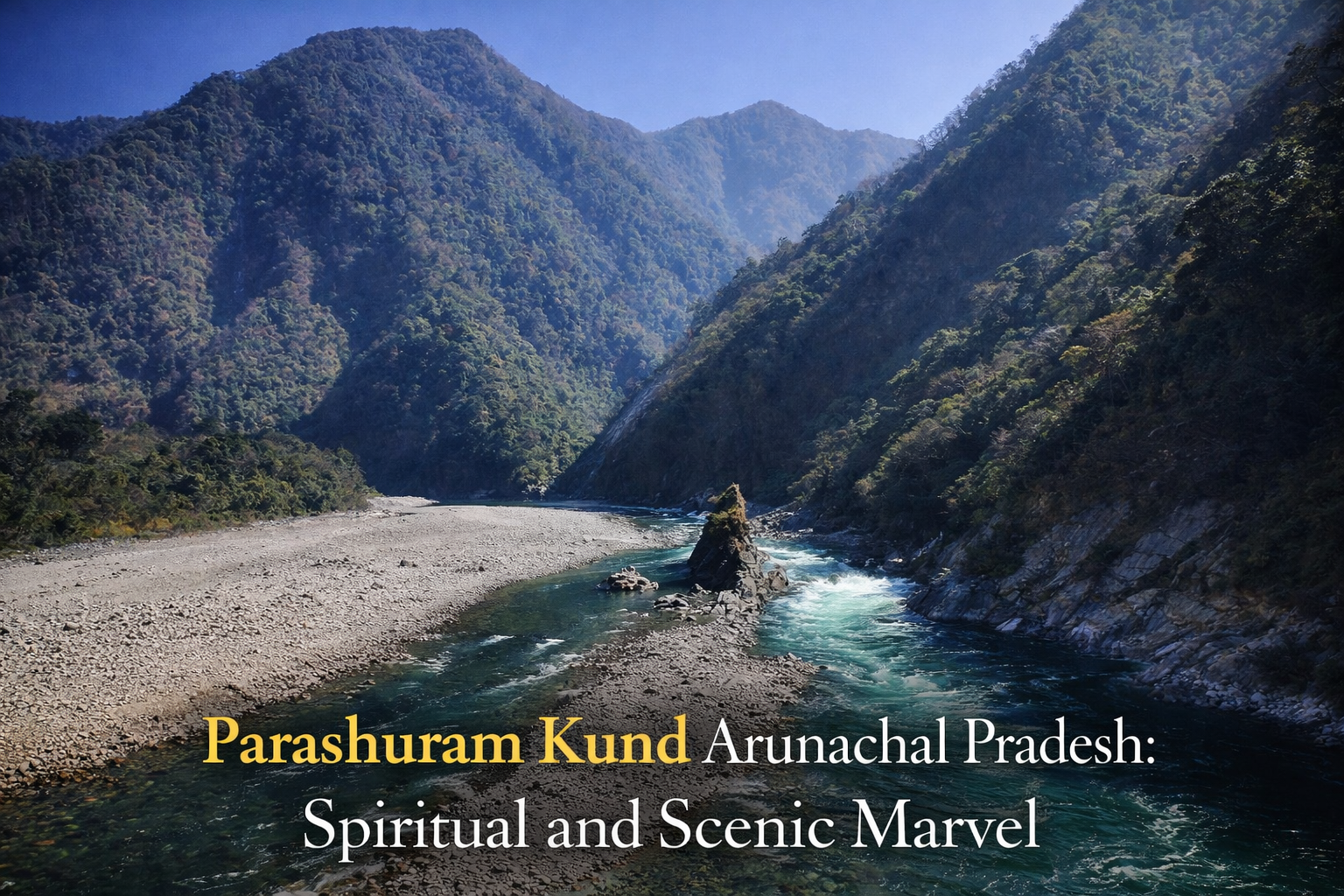
Parshuram Kund is like a Hindu pilgrimage spot, and as for the religious significance of Parshuram Kund? It acts as a holy place of worship. The Parshuram Kund temple was built to honor sage Parshuram. The temple is situated near the Lohit river. It is believed that those who dip themselves in the Lohit river, the holy river, will wash away any sins. Due to this belief, around 70,000 devotees come to take a dip in the Lohit River, here at Parshuram Kund.

Parashuram Kund Arunachal-Pradesh

Parshuram Kund Mela:
The Parshuram Kund Mela is celebrated every year as a result of Makar Sankranti. The Parshuram Mela is hosted here every year from the 1st of Jan all the way to the 31st. During the mela, many mountain tribes bring down cows, rare fur rugs, and other animals. During the Parshuram Kund Mela, the department of tourism has been working with the district administration to make grand arrangements since 1972. They also take care and ensure that other public needs are taken care of such as shops, clean drinking water, edibles, and safe lodging.

How to Reach Parshuram Kund:
Parshuram Kund is located in Arunachal Pradesh and is on the Brahmaputra plateau, close to the Lohit River.

By Air:
To reach Parshuram Kund in Arunachal Pradesh by air one can catch a flight to Dibrugarh airport, which is around 200 kilometers from here, and from there they can hire a cab or catch a bus to Lohit river.

By Road:
Parshuram Kund is easily accessible by road and there is a good road system implemented. There are many car rental services available in this area, to help tourists easily reach there.

By Rail:
Unfortunately, there is no direct route that makes Parshuram Kund accessible through rail. The railway station nearest to Parshuram Kund is in Tinsukia which is around 160 kilometers away. So once you arrive there you could make use of the many car rental services or hire a cab to take you to Parshuram Kund.

Credits:
Sikta Panigrahi provided the Peacock island images used in this Srikakulamads article. We thank him for these fantastic shots! The second peacock island image was produced as a result of his talent. You can check out his Instagram @coolcapturre/

Lalbagh Botanical Garden Bangalore Karnataka: A Green Paradise

Lalbagh is a well-known botanical garden in both Bangalore city and some other parts of India. This garden has a wide array of flora and fauna. Lalbagh brings glory to the city of Bangalore and is one of the major tourist attractions in Bangalore.

Lalbagh Botanical Garden History:
Lalbagh park was originally laid out across 40 acres by Hyder Ali, the emperor of Mysore. Afterward, the garden was completed by his son, Tipu Sultan. Then during the reign of the Wodeyars and British empire, the park was expanded. Tipu Sultan had brought in plants from the far corners of the world to add to the park’s wealth. He had imported plants from France, Persia, and even Afghanistan, so he could improve Lalbagh horticulture.

About Lalbagh Botanical Garden Bangalore:
This botanical garden is full of greenery, and lakes. Teeming with beautiful trees and lush greenery, it brings pride to the extensive range of Lalbagh horticulture. Today, Lalbagh park is spread across 240 acres of land near the heart of the city as it lies only a distance of about 4 k.m from MG road. Lalbagh park is a pristine example of why the city of Bangalore is known as the ‘Garden city’.

Things to do here:
The time that you spend here at Lalbagh botanical garden is solely based upon your interest. For example, many fitness fanatics like to go for an early morning jog. There is also a working analog floral clock that you can check out! By the way, did I mention there is a lotus pond? Yes! That’s right you can go for a stroll by the lake enjoying the nice view. Also, one could click some nice photos to capture the beauty of nature, or even to preserve some family fun for the photo albums!

Things to see here:
Topiary Garden:
It is things like this that make Lalbagh botanical garden so special. It is the creativity that Lalbagh brings that makes it great! This section of Lalbagh Bangalore projects plants like Junipers in different shapes! That is what makes it fun for children as they run around identifying animals like lions, and elephants.

Tree Fossil:
This tree fossil was brought in from the great state of Tamil Nadu. It is a 20 million-year-old fossil of a coniferous tree.

Bonsai Garden:
The bonsai collection here at Lalbagh hosts an extensive variety of 700+ bonsai plants.

Pigeon Colony:
This entire place is located at one of the Lalbagh main gates – the West gate. It was built in 2007 with the sole intention of attracting pigeons.

Bombax Tree:
This is a massive tree that is close to the Lalbagh west gate, beside the topiary garden.

Kempegowda Tower:
Lalbagh Botanical Garden, Bangalore also hosts the majestic Kempegowda tower. It is a well-maintained watchtower that was aesthetically enabled and was originally meant to be a territorial marker.

Lalbagh Flower Show:

Lalbagh-Botanical-Garden-Bangalore-Karnataka

The Lalbagh flower show is conducted twice a year. These flower shows occur annually during January and August in light of republic day. The Lalbagh flower show is something everyone should get a chance to see!

Lalbagh Glass House:

Lalbagh-Botanical-Garden-Bangalore

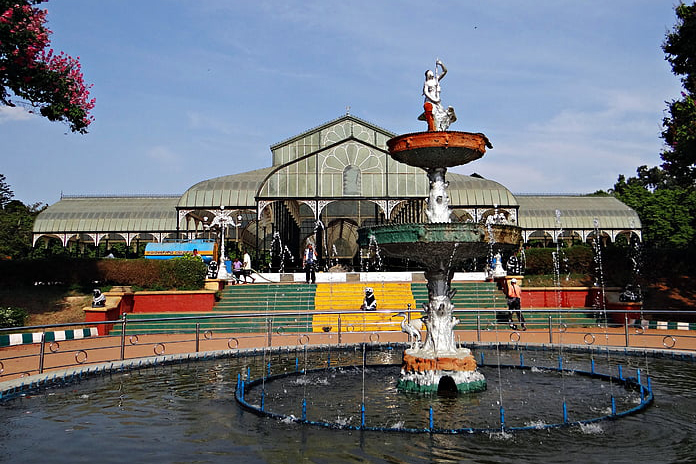
Lalbagh botanical garden also contains an exquisite glasshouse, which was modeled after London’s crystal palace. This glasshouse hosts the Lalbagh flower show twice a year. When one visits this glorious park, they will be compelled to take a look at this exquisite structure.

Best time to visit:
The best time to visit Lalbagh garden is in January and August, the garden will be in its peak with full bloom! It is just a wonderful sight to see!

Timings and Entry fee of Lalbagh Bangalore:
The Lalbagh Botanical Garden Bangalore timings are: 6 am to 9 am if you want free entry so that you can go for a nice morning walk. Lalbagh botanical garden opening time is the same 7 days a week. If you are over 12 years old you will be charged an entry fee of Rs. 20. Want to take a few clicks? Well, visitors with a camera will be charged an extra Rs.50.

Traveler Tips:
1. Food will not be allowed inside the park. So it is better to eat before you come, or eat at the snack stalls inside.
2. Visitors will be able to visit the flower show by entering from any of the four gates.
3. Flower show tickets can be bought online.
4. They do not allow disposable items such as plastic bottles.
5. Car parking facilities are quite spacious over at the East gate of Lalbagh, facing the Double road.

How to reach Lalbagh Bangalore?
Lalbagh Bangalore with its prime location is very accessible and connected to the city. Ample buses make stops at Lalbagh gates. Kempegowda bus stand is also available at a distance of 7 kilometers. Visitors already in the city can also hire a cab or an auto-rickshaw with ease.

Credits:
Gourav provided the Peacock island images used in this Srikakulamads article. We thank him for these fantastic shots! The second peacock island image was produced as a result of his talent. You can check out his Instagram @__gouravvvvvv_/

Kunchikal Falls Karnataka: Hidden Beauty of the Western Ghats

There are numerous waterfalls in India, one among them is the Kunchikal Falls in the Western Ghats of our country. The cascading waterfall seems like a part of heaven seen on earth. The view of the waterfalls is mesmerizing and the sounds made by birds in the vicinity of waterfalls are harmonious.

About Kunchikal Waterfalls:
Kunchikal Waterfall in India is situated amidst the dense lusty forests near Agumbe hill station and Hulikal Ghati temple. The descent of the Varahi River creates this impassable waterfall. It falls from a height of 455 meters. Kunchikal Falls height in feet would be 1493 feet.

Kunchikal Falls were once lasting and full of life all through the year, but after the development of the Mani Dam, the water was moved to the dam to create power through the hydroelectric plant built close to Hulikal, Shimong. Presently, the stream is once in a while overwhelming. The dam limits the public drive into the range resulting in a smaller number of visitors.

Nevertheless, the foamy and milky waters of the Kunchikal Waterfall are quite captivating.

What is unique about Kunchikal Falls?
Kunchikal Waterfall is assessed to be higher than the Jog waterfalls.
It is the most elevated waterfall in India as per the World Waterfall Database.
Kunchikal Waterfall is positioned 116th among the World’s Highest Waterfalls.
It comprises four tiers over a run of 1500.ft long.

Other little waterfalls are encompassing the Kunchikal waterfall, those streams are from the Varahi river

It is the primary contributor to the generation of hydroelectricity in the state of Karnataka.
South Canara forests and Barkhana falls can be observed by you, from this place.
Kunchikal Waterfall is well-maintained by the government and is one of the most unpolluted and pristine ones in the area.

Things to do:
Kunchikal Waterfalls is one of the most peaceful and beautiful picnic spots to visit with all the family members.

Kunchikal Falls is also a popular trekking spot. Hence, carefully monitored trekking can be done.

Things to avoid:
As the water flows from a tremendous height, taking bath and playing in the water flow is extremely dangerous if the water flow is heavy.

The Western Ghats are home for different flora and fauna including Giant Indian squirrel, Indian bullfrog, and other unique birds, rare reptiles, and wild animals. So, traversing around Kunchikal waterfalls is not advisable. Be extremely cautious if children are with you.

Best Time to visit:
Since most of the water is transferred to the dam for the generation of power, the water stream and current are tall only within the monsoon season. It is from July to September. A cool breeze blowing around the woods, sprinkling rain pouring from the sky, the sparkling-fairy Kunchikal waterfalls tumbling down the rocks, the reverberating sounds of the stream of water, the pleasant chirping of birds all together make the magnificence of the view to be beyond your imagination. So, the best time to visit the waterfalls is amid the monsoon season.

Kunchikal Falls Karnataka

Timings:
The hours allocated for visitors are 6 am to 6 pm, the hours of service may differ depending on the day or the season.

Traveler Tips:
There is no proper residential facility available around the Kunchikal Waterfall, whereas dine-in restaurants are available for resting and eating. So, you must look upon the place of stay in advance itself.

The entry to the Kunchikal Waterfall is restricted, and a gate pass is required to enter the waterfall area. The pass will be issued at Hosgandi village, 15 km away from the waterfalls. It is free of cost.

Places to Visit Nearby:

Agumbe:
Favored with wealthy biodiversity, Agumbe gives an enhancing encounter. Agumbe could be a small village, and a slope station, arranged within the Shimoga locale of Karnataka.

Journey along the wild paths and experience the raw magnificence of the wild nature. It could be a marsh rainforest with the second-highest yearly precipitation in India. Hence, it is known as the “Cherrapunji of South India.” It was the shooting setting for the celebrated Malgudi Days show!

Barkana Falls:
Barkana Falls had made its put within the ten highest waterfalls of India. It is shaped by the Seetha Waterway and shapes a perfect pool underneath. It is found close to Agumbe and offers a glittering sea of the cascading waters.

Bhadra Wildlife Sanctuary:
The mountains of the Western Ghats serve as a crown to this aphrodisiac park. It is home to wild tigers and different biodiversity. You can spot the Bhadra Waterway streaming through the Sanctuary, giving life to various species. It is moreover known as ‘Muthodi Natural life Sanctuary’ and is a 2-hour trip from Kunchikal Waterfalls.

Sringeri:
Sringeri is a divine site where the goddess of education ‘Saraswati’ resides. It is prominently believed that the blessings of this goddess would enrich your mind and memory. It is a devotional destination around 66 kilometers from the Kunchikal Waterfalls.
Sringeri is an abode to peace and comes with baffling history. It is believed that Adi Shankaracharya found a snake unveiling its hood to shelter a frog from the scorching sun.

How to reach Kunchikal Falls?
Kunchikal Falls is located in Nidagodu village near Masthikatte in the Shimong-Udupi district border of Karnataka state.

Railways:
Udupi railway station is the closest to Agumbe, approximately at a distance of 67 kilometers.

Airways:
Mangalore airport is the nearest being 142 kilometers away from the waterfalls.

Roadways:
The region is connected through roads to major cities like Bangalore, Mangalore, Mysore, etc. There are coordinated buses from Bangalore to the Kunchikal waterfall.
People can take taxis, private vehicles to the Kunchikal Waterfall in India once they reach the adjacent city through street rail or aviation routes. The final kilometer to reach the waterfalls is slippery with rocks and mud, so it is vital to stay cautious.

Kunchikal Waterfalls is one of the foremost lovely manifestations of nature, where the sky and the waters come alive. Savor the smooth stream of the Varahi Stream cascading down the Agumbe hill. The climate resonates with the ensemble of the streaming and tumbling waters. Wake up from the rigidity of daily life and delight within the eminence of Kunchikal Waterfall in India.

Credits:
Jog Bharath provided the Peacock island images used in this Srikakulamads article. We thank him for these fantastic shots! The second peacock island image was produced as a result of his talent. You can check out his Instagram @bharathjog/

Jog Falls Karnataka: India’s Majestic Waterfall Wonder

Jog Falls in Karnataka is a symbol of the eternal beauty of nature. The mountains give the freshness to breathe freely in nature. The valleys covered with flowers give an alluring vista. But this beauty is incomplete without the charismatic and grand falling stream of water.

About Jog Falls in Karnataka:
Jog Falls in Karnataka provides a bewitching view, making it a glorious wonder of nature. Its height is about 253m (830ft). The water thunders down the slope losing contact with the rocks, which makes it the 2nd highest plunge waterfall in India. The flow of the Sharavathi River is an exquisite sight to watch.

Jog falls in Karnataka are locally known as ‘Gerusoppe falls’ and ‘Jogada Gundi’. “Joga” is a Kannada word meaning fall. The water flows down into four distinct falls, namely: Raja, Rani, Roarer, and Rocket. The Raja Fall meets the Roarer at an angle of forty-five degrees.

Witness the Roarer that precipitates itself into a vast cup meeting the Raja that flows unbroken up to 830 feet. Rocket and Rani are no less! The Rocket shoots downward in a series of jets while Rani moves quietly in a sheet of foam.

The viewpoint is in Sagar taluk, Shimoga district. A set of 1400 steps carry you from the viewpoint to the bottom of the hill. The steps are an initiative by the Tourism Department to facilitate your experience.

Things to do:
Head to the backwaters to relish the adventure. A spike in adrenaline and a touch of adventure is all we need. There are a load of activities such as archery, river rafting, trekking, angling, boating, kayaking, swimming, and camping. Lastly, do not forget to soak up warmth from the glow of the bonfire!

Traveler Tips:
If you are planning to visit Jog Falls in the monsoon season, then the weather will remain rainy, foggy, and misty during this time.
Keep your raincoats and umbrellas handy and be patient for the clouds to move away from the waterfall.

Linganamakki Dam and Jog Falls:
The Linganamakki Dam is located in the Sagara town, which is about 11 kilometers away from the Jog Falls. Special permission is required to visit the main dam. However, all visitors are allowed to see the dam from the viewpoint. The entire surrounding area of the Linganamakki dam is full of lush green plantations and incredible natural beauty.

Associated with the waterfall is the nearby Linganamakki Dam across the river Sharavathi. The power station has a capacity of 120 MW and has been functional since 1948. Interestingly, it was one of the largest hydroelectric stations in the year 1948. However, it is just a small source of electric power for Karnataka today.

This Dam was known as Krishna Rajendra hydro-electric project in the early days. It was named after the Ling of Mysore. Later, it was renamed as Mahatma Gandhi hydro-electric Project. After the end of 1960, Linganamakki Dam was being used for generating power thanks to Sir M. Visvesvarayya.

Jog Falls is a mere pair of thin streams of water that trickles down the cliff during the summers and winters. The water from the river gets used up for the generation of electricity. When the dam overflows during peak monsoon season, the gates are opened and all that water then flows down the Jog Falls in Karnataka.

“THERE ARE DIVINE THINGS, MORE BEAUTIFUL THAN WORDS CAN EXPRESS.”

Jog Falls Entrance Timings:
Jog Falls Timings are from morning 7:15 AM to evening 8:15 PM on all days except Sundays. On Sundays, you can visit this place from 7:15 AM to 9:15 PM.
However, you can go down to the base only between 9 AM and 4 PM.

Ideal Duration:
Ensure that you have got around 2 to 3hrs to completely explore the beauty of Jog Falls in Karnataka.

Laser Show:
Man’s creativity has never known bounds. That’s why the scenic beauty of nature fuses with artificial lights to provide a scintillating experience. Enjoy the dance of the lights in the flow of the water.

Make sure you arrive by 7.15 PM, for the show begins at this time. If you are visiting on Sundays, the show would be terminated by 9.15 PM. On all other days, this colossal show ends by 8.15 PM.

Musical Karanji Show:
Does a musical event amidst the symphony of nature sound enticing? The show timings are the same as the laser show timings.

What can be more perfect than the cool breeze, gushing waterfall, the play of light, and the melody of music all fused together?

Best Time to Visit:
The best time to visit Jog Falls is in the monsoon season, which is from August to January, though the peak tourist season is from September to December. The months of monsoon offer a spectacular vista of the cascading glory of Jog Falls in Karnataka.

Nearby Places to Visit:
Honnemaradu:
Honnemaradu is a place located atop a hill that overlooks the Linganamakki reservoir. It literally means ‘A Golden Lake’ and is known for the spectacular sunrises and sunsets. The island offers a variety of water adventure activities like kayaking, canoeing, and rafting and is a perfect spot for a picnic. Honnemaradu is famous amongst trekkers and bird watchers as they can spot rare species of attractive birds here, and indulge in trekking nearby peaks.

Sharavathi Valley and Suspension Bridge:
Sharavathi valley viewpoint and Suspension Bridge lie on the way from Honnavar to Jog Falls. It is situated in the Honnavar taluk, Uttara Kannada district which is 35 kilometers away from the Jog Falls Karnataka. The bridge is built over the ferociously flowing Sharavathi River and connects two nearby villages. The locals traverse using 2-wheeler vehicles on the bridge.

How to reach Jog Falls:
Jog Falls of Karnataka is situated upon the Sharavati river located in the Western Ghats in Siddapur taluk, Uttara Kannada District.

By Air:
Hubli airport is the nearest airport to Jog Falls sited 130 kilometers away from Jog Falls. From Hubli airport, you can either hire a taxi to Jog Falls or catch a state-run bus to Jog Falls from Hubli bus stand.

By Rail:
Talaguppa railway station is the nearest railway station to Jog Falls (about 14 kilometers away from Jog Falls). The Talaguppa rail line is well connected to Bengaluru (Bangalore), Mysore, Shimoga, and Sagara. The meter gauge rail track between Shimoga and Talaguppa was laid by the British in the late 1930s.

The Sagara railway station 30 kilometers away from the Jog Falls is the second closest railway station. If you are coming from the northern parts of India, you can catch a train to Hubli railway station in Karnataka. From Hubli, Shimoga can be reached via road, from where you can take a train or taxi to Talaguppa.

By Road:
Jog Falls is nicely connected by well-laid smooth roads from both the sides – Honnavar and Shimoga/ Sagara. Jog Falls is 85 kilometers away from the temple town of Murudeshwar and 111 kilometers away from the beach destination Gokarna. Gokarna, Murudeshwar, and Jog Falls make a wonderful combined road trip.

How to reach jog falls from Bangalore?
Jog Falls also makes for an amazing road trip from Bangalore. Bangalore to Jog Falls distance would be about 410 kilometers. You can easily reach from Bangalore to Jog Falls via any private vehicle or hire one. While you are at it, do not forget to visit the destinations in Bangalore before visiting Jog Falls of Karnataka.

Explore this cascading wonder in the Southern state of India. We welcome you to witness the natural marvel and revel in the beauty of this serene waterfall. The flow of a waterfall and time can never be reversed. So make sure to pack your bags, and head on this journey!

Credits:
A picture says more about a place than any writer can ever hope to do. Srikakulamads would like to thank Subhadip Choudhury, for providing us with excellent photos to share with you all! You can also check out his Instagram @shivu_gouda45/

Dassam Falls in Jharkhand: A Spectacular Waterfall Retreat

Location: Ranchi, Jharkhand
Elevation: 336 m (1,102 ft)
Height of waterfalls: 40 m (144 ft)
Watercourse: Kanchi river

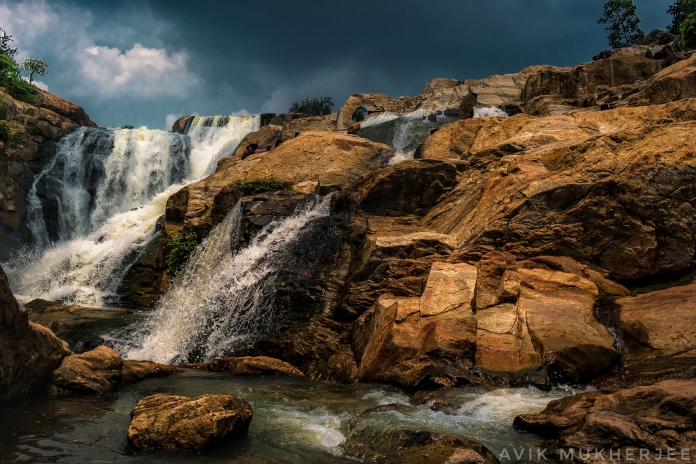
Dassam falls in Jharkhand are also known as Dassam bagh. They are waterfalls that cascade in the Indian state of Jharkhand, formed by river Kanchi, a tributary of the Subarnarekha river. Dassam waterfalls are located near Tamaira village in Ranchi.

The atmosphere is full of the echoing sounds of falls that can be heard all over the place. The waters of Dassam falls are crystal clear and represent sheer purity. This beautiful waterfall is in fact a fusion of 10 water streams cascading all at the same time.

Dassam falls in Jharkhand are also known for their natural beauty and picturesque view. Dassam falls are surrounded by lush greenery that attracts visitors from across the world. It is interesting to know that around 6 million people visit Dassam falls annually.

You can unwind and relax when you are surrounded by the melody of the echoing sounds of the cascading water. The tunes and melody which one encounters here is a different feeling altogether.

If you are interested in recreational activities, there are facilities provided near the Kanchi river. However, you have to be careful! It is not recommended to play or take a bath in, as it’s very dangerous, especially for kids.

It is a good place to visit to get away from the polluted, bustling life of the city. One can also try a bit of trekking behind the falls. However, it is quite a bit of risk. The picturesque landscape and the serenity make this a perfect picnic destination.

Etymology:
Earlier Dassam falls were pronounced as da-song falls. Da-song is a Mundari word that means the act of pouring water. The name was changed because people from various places found it difficult to pronounce this dialect.

Dassam-Falls-in-Jharkhand

Efforts made by the State government:
To develop Dassam falls as a mainstream tourism spot, the government has initiated many developmental projects. Stairs and platforms have been built way down to the base of waterfalls; to view and enjoy the beauty of the waterfalls. However, it is best to avoid slippery rocks. The state government’s endeavor has enabled us to take a closer look at Dassam falls. It is a fabulous chance to explore the beauty of natural creations.

Best time to visit:
The best time to visit Dassam falls is during winter and summer. You may avoid visiting Dassam falls in monsoon as the force of falls is strong and intense during the monsoon. During winter and summer, it is a very calm and serene place that can soothe you.

Timings:
The Dassam Falls can be visited any time from 8:00 am to 6:00 pm
It takes around 2 hours to visit the falls completely. Therefore plan accordingly! It is completely up to you. You may also choose to spend more than two hours at this destination and enjoy its beauty.

Dassam-Falls-Jharkhand

Things to be taken care of during your visit:
We recommend you to be careful and avoid taking a dip in these waters. Over time, the flowing waters have created many narrow tunnels between the rocks that go beneath the water. Hence, if someone drowns they are likely to get stuck in these complex tunnels beneath. The rapid water flow doesn’t allow them to swim back up. Consequently, a struggle ends in a painful death.

How to reach Dassam Falls Jharkhand:
The Dassam Falls in Jharkhand is very easy to reach, and one can access them via air, train, or road!

By Air:
The nearest airport is Birsa Munda Airport which is around 31 kilometers away from the falls.

By Train:
The nearest railway station is the Ranchi railway station situated around 26 kilometers from this destination.

By Road:
Birsa Munda Bus Stand Kantatoli is 24 kilometers from Dassam falls. The road to Dassam falls is well maintained and good. It is not too cramped and packed with traffic. Hence a road trip would be smooth and peaceful. You can easily reach Dassam falls via road.

We all know that nature is the greatest architect in the world. Dassam Falls is a luxurious gift that nature has bestowed upon us. A trip to this destination will refresh you. We all deserve a retreat and refreshment. Why not plan a trip to Dassam Falls? A perfect getaway in the laps of nature.

Credits
To capture the beauty of a place in still moments is an art. We appreciate Avik Mukherjee, for the photographs which have been used in this article. So thank you Mr. Mukherjee for giving us a great set of pictures, each of which speaks more than a thousand words. You can check out his great work on Instagram @avikininsta

Dalma Wildlife Sanctuary Jamshedpur Jharkhand: Explore the Rich Biodiversity

Location: Jamshedpur, Jharkhand
Area: 195 sq km.
Elevation: 3,000 ft
Geography: Dalma Wildlife Sanctuary Jharkhand is abundantly rich in SPS and North dry mixed Deciduous forests. The park is surrounded by the hills of Dalma up to 915 ft.

About Dalma Wildlife Sanctuary:
Dalma Wildlife Sanctuary is renowned for its forest tourism, but locally it is known for its wild elephants. In the Jamshedpur region, the terms ‘Dalma Haathi’ or ‘Dalma’s Elephants’ are considered to be well known and represent a rather fearful backdrop. Dalma Wildlife Sanctuary was established in 1975 and inaugurated by Sanjay Gandhi.

The Dalma forest also harbors a diverse range of species including animals, birds, and vines. Overlooking the shimmering Subarnarekha River, Dalma hilltop Wildlife Sanctuary nestles like a descendent in the dense green forest. The ambiance of the forest and the opportune moment at which one can get a peek at the wild animals is what makes Dalma so unique among those who love to fly around jungles.

Dalma is also referred to as, “The Elephants’ Paradise.”

The wildlife area also includes paths for wildlife views. The reserve has also been installed in a small temple dedicated to Lord Shiva. During the Shivratri festival, devotees visit this glorious Shiv temple. You can walk along the steep slopes and rough terrain in the reserve. You can also arrange overnight accommodation. There’s a lush green setting in the wildlife sanctuary, with plenty of vegetation and large trees, shrubs, and bushes. Eco Huts have been designed for lovers of nature where they can look at nature in the wild.

Dalma Wildlife Sanctuary Timings:
Timings in Summer: 7 a.m. to 5 p.m.
Timings in winter: 7 am to 5 p.m.

Entry fee:
Tourist entry fee: INR 05/-
College children’s entry fee: INR 02/-
No fee for disabling peoples
Bus/truck entry fee: INR 350/-
Minibus/matador entry charge: INR 250/-
Car/jeep entry fee: INR 150/-
Phone charge: INR 80/-
Video charge: INR 500/-

Best Time to Visit:
The months of October to March are the best time to visit the Dalema Hilltop Sanctuary. The winter weather is good, with an average daytime temperature of 26 ° C. The night’s temperature cools down to 11 ° C with a temperature arrangement.

Do not visit the park in April to September if the daytime temperature rises to 38 ° C.

DALMA WILDLIFE SANCTUARY HOUSES A LARGE RANGE OF MAMMALS, 84 BIRD SPECIES, AND 300 PLANT SPECIES

.

FLORA:
Because the selective forest plundering by wood mafia over many years creates harsh conditions for animal inhabitants, the forest cover is denuded by up to 90%.
Trees: Mango, Guava, Limon, Mahwa, Jamun, Sheesham, Neem, Baabul, Bamboo.

Dalma-Wildlife-Sanctuary-Jamshedpur-Jharkhand

FAUNA:
Wild Animals: Indian Elephant, There are also Indian giants in the sanctuary, sloth bear, barking deer, wild boar, porcine, mouse deer, pangolins, and mongooses, Giant Squirrel, Sloth Bear, Barking Deer, Wild Boar, Piggie, Mouse Deer, etc.

Birds:
In the sanctuary, the birds that were commonly seen are falcons, golden oriole, Indian treepie, paradise fly cattle, gray horns, Indian peafowl, various varieties of Kingfishers and herons, egrets, mynas, pigeons, Racket-tailed Drongo, Magpie Robins, Red Bulbul-whiskered, Red-vented Bulbul, Brahminy Myna, Common Myna, Asian Köl.

How to reach Dalma:
Jharkhand is located on the NH-33, at a distance of 33 km from Dalma Wildlife Sanctuary. The sanctuary does not have a direct connection. The sanctuary can be reached by renting a private car or taxi. The robust land to the Makulakocha Check Post sanctuary is perfect for SUVs.

By Air:
Birsa Munda Airport in Ranchi is the closest airport to Jamshedpur. Ranchi has good public transport connections to Jamshedpur. From the bus station Ranchi (5 km from Ranchi airport) you can take a bus to Jamshedpur. The Birsa Munda Airport is about 130 kilometers away from Dalma Wildlife Sanctuary, which via NH43 would take around 3 and a half hours.

By Train:
There are multiple trains running weekly between Delhi and Jamshedpur. The quickest train to carry you from Delhi to Jamshedpur in 17 hours is Bhubaneshwar Rajdhani. The Jamshedpur railway station is called Tatanagar. The distance between Taganagar junction and Dalma Wildlife Sanctuary is around 40 kilometers, which is about a 90-minute car journey away.

By Road:
A hired car, preferably an SUV for better security on upward forest paths, is the only way to get into the forest for the tourists. The road system at Jamshedpur is not too bad, and one can easily access Dalma Wildlife Sanctuary. Dalma often gets many visitors from Kolkata, they can take NH16 and NH18 which is around 312 kilometers.

Things to do:
1. Way of Nature – Only morning operational and Payment: INR 100
2. Join the Temple of Lord Shiva
3. Nichlabandh / Majlabandh
4. Makulakocha Center of Interpretation Museum
5. Hanuman Temple
6. Pindrabera FRH
7. Bamboo hut
8. Deer Enclosure
9. Elephant Rescue Center

Dalma Wildlife Sanctuary Safari:
Unfortunately, like most of the other Wildlife Parks, Dalma Wildlife Sanctuary does not provide a safari option.

Dalma Wildlife Sanctuary Jharkhand is an excellent place to visit with family and friends. It provides a nice getaway for those looking to have some time away from the bustling cities they are used to, and adore the unique species here at Dalma!

Credits:
Apna Purulia provided the Peacock island images used in this Srikakulamads article. We thank him for these fantastic shots! The second peacock island image was produced as a result of his talent. You can check out his Instagram @apna_purulia_wb/